Showing posts with label Foreign Policy. Show all posts

Tuesday, March 25, 2008

On Nuclear Weapons


The years of the Cold War are over, and with them the tensions between the great nuclear Powers of the United States and the Soviet Union. The Soviet Union has fallen, and its successor, Russia, is hardly in a position to challenge the United States for supremacy. Moreover, even though Russia and the United States still possess nuclear weapons, there is no potential dispute on the horizon between these two nuclear Powers that could possibly involve nuclear weapons. Yet each nation still stockpiles large quantities of strategic and tactical nuclear weapons. Is this really necessary?

The answer is, I think, largely no--yet there is a crucial caveat to this "no." The most each nation needs is 1000 warheads stockpiled, preferably mostly not on hair-trigger readiness. On the other hand, once nations have nuclear weapons it would be irresponsible and imprudent to get rid of them completely. The only way nuclear weapons are going to disappear from the world is if they are rendered obsolete, which is not on the horizon. The nature of such weapons is such that even if the major nations of the world were to get rid of them, some small nation would no doubt get them and hold the rest of the world to ransom, or come some war the race would be on to re-make nuclear warheads before the other guy. So while continued reductions in nuclear warheads are good, it is highly unlikely that they will disappear, and not a good idea, I think, to talk about getting rid of them completely. Which is why the Bush administration's plans to produce a new ICBM are appropriate and prudent, because they recognize that they cannot let their guard down while other nations still have these weapons. Deterrence will still be necessary, probably for as long as these nations exist. But they should seek to mitigate the threat these weapons pose to world peace, and limit their stockpiles and preparedness.

Friday, February 29, 2008

On Terrorism


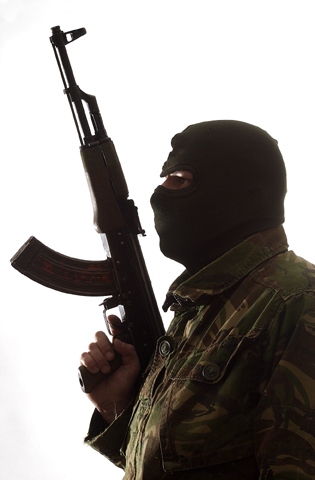
An important issue in politics today is the nature of the War on Terror; how it should be waged, if it should be waged, what rhetoric we should use, what means we should use, are all topics that are debated. This post will deal with whether or not we should call those who are the antagonists to the West in this conflict 'terrorists.'

It is an important thing to remember that although 9/11 brought the subject of these kinds of movements and their activities to the forefront of American popular thinking, they are not a new phenomenon. For many years previous to this date the problem of militant organizations carrying out attacks against civilian populations has been one of the issues of foreign policy for most nations. The nation of Israel has dealt with this problem for many years, as has Lebanon, Russia, and the Philippines. Moreover, there have been many movements that do not specifically target civilians, yet are called 'terrorists' by their foes; witness the African National Congress in South Africa during its militant days, the ETA among the Basques, and many others (during the occupation of France during the Second World War, the Germans called the Resistance 'terrorists'). So clearly the term 'terrorist' has been used to describe a wide variety of militant organizations, some of which had good aims, and others which had evil aims (in our eyes).

So the argument runs, 'those who carried out the attacks of 9/11 and who are targets of the War on Terror are merely like the French Resistance, who resisted oppression.' After all, hasn't the West done terrible things in the past against the ethnicities from which the militant organizations spring? It must be admitted that the grievances that Al-Qaeda and others like them claim against the West are not completely illegitimate; after all, if they were all untrue there would be no resentment against the West that would spur new recruits to join. Yet even if these arguments are true, and they are almost always grossly exaggerated and decontextualized, it would still not give Al-Qaeda and their ilk an excuse to take the actions that they have taken.

There is a fundamental difference between proper resistance to oppression and improper resistance, or terrorism. Proper resistance does not specifically target civilian populations. As an example of this, the ANC in South Africa always targeted military and government installations when they rebelled. Now, even this in the situation was inexcusable (which is why Nelson Mandela is a lesser man than Mohandas Gandhi in terms of resistance movements) but nevertheless could not be classified as terrorism. Terrorism specifically targets civilian populations to make a political point, and to cause political change. It is useful to apply the measures of just war to the actions of Al-Qaeda: Proper cause--perhaps; but very open to debate; proper authority--no, as no government has authorized them; no targeting of civilians--no, indeed the whole point of their attacks is to target civilians and so to spur fear in them; proportionality--more difficult, but in general the attacks of terrorists are indiscriminate and so show no care for proportion at all. In all these things terrorism fails to meet the justification of just war.

The words 'terror' and its variants are useful words that should be used very precisely to refer to certain organizations and actions that meet the following criteria:
1) Not a government body, and in the case of actions not authorized by a government body (when governments use these tactics in a war, it is called something different)
2) Commit acts of violence against specifically civilian targets; namely, the using of civilians as pawns to force their governments to do things (once again, when governments use these tactics it is called something different)
Nationalist movements are sometimes terrorist movements and sometimes not; yet the people who perpetrated the 9/11 attacks are not specifically nationalist but rather global. Al-Qaeda has as its aim the intimidation of Western governments so that an Islamic empire may re-emerge. This is not a strictly nationalist aim, but rather a religious/utopian one, one which makes them and those like them all the more odious and so deserving of the epithet 'terrorist.'

Governments doing the acts that terrorists do are committing war crimes or oppression; but by definition terrorists cannot commit war crimes as they are not engaging in war, which must be authorized by a government, and they cannot oppress anyone as they do not rule anywhere. So the term 'War on Terror' is a useful one and should be kept, so long as it is clearly understood who is targeted: organizations like Al-Qaeda that target civilians for political ends.

Friday, February 1, 2008

Wall Street Journal on Harper's NATO Dare

The Wall Street Journal seems to agree with Harper's position on Afghanistan.

Notice the excellent pixellated portrait of Harper. It is comforting to have a stalwart conservative paper come out in favour of the PM's stance.

Wednesday, January 30, 2008

On the Canadian Mission in Afghanistan


The other day Prime Minister Harper stated in his response to the Manley Report on the Afghanistan mission that he would respect the report's recommendations. The key element in these recommendations was that unless NATO provided an addition 1000-man battle group to help in Kandahar, the Canadians would withdraw.

It is regrettable that it has come to this, having to threaten to leave a vitally important mission if our allies won't step up to the plate, and I can't help but feel that we should stay anyway. On the other hand, more troops are needed and if we don't get them, the mission may well fail long-term. Hopefully NATO will come up with the 1000 troops needed and we can continue to play our important role in the conflict. It has often been said that the government has failed to state clearly the reasons why Canada is in Afghanistan, for there are compelling reasons why this mission ought to succeed.

There are several perspectives from which a government must approach a decision like this one. Firstly, and most importantly for a government, the perspective of national interest. A government is instituted to prudently guide a nation in its dealings with others, and must think primarily in terms of its own interest; in other words, it must be selfish in the sense of the nation as "self." The invasion of Afghanistan by the Western powers, led by the United States, came about because of the attacks of 9/11. In the aftermath of the attacks, the American government quite rightly demanded that the current (sort of) government of Afghanistan, the Taliban, surrender to it the planners and enablers of the attacks; namely, Al-Qaeda. The Taliban, who had been sheltering Al-Qaeda for many years, refused this request and so it was deemed necessary by the Americans, with the full concurrence of its allies, to remove them from power. This was done, with the aid of the rebellious warlords of the Northern Alliance, and Afghanistan became a zone in which Al-Qaeda and its allies could no longer safely shelter. And here is the first reason why Canadian forces must remain in Afghanistan, and the most compelling: to prevent the Taliban from regaining territory that they can safely operate in and in which they can shelter entities such as Al-Qaeda. The attacks of 9/11 were attacks on Canada not only because of our NATO obligations, but also because around 30 Canadian citizens died as a result. These attacks were made possible because of the safe harbour of Afghanistan, a country which is uniquely suited for hiding entities like Al-Qaeda due to its lawless and decentralized nature. Therefore, it is definitely in the national interest of the government of Canada to contribute considerable resources to the maintaining of a Taliban-free and Al-Qaeda-free Afghanistan.

Secondly, a government must consider the moral perspective. The virtue that ought most to define government, prudence, is dealt with above; the other virtues, like compassion, are dealt with here. This perspective on the mission in Afghanistan is more tentative, because it is not a government's primary duty to root out evils beyond its own borders that do not threaten it directly. On the other hand, the government cannot just ignore gross injustices that occur around the world, and it is often necessary to act to end these injustices. Afghanistan under the Taliban was a place in which gross injustice happened fairly often: women had no rights, repressive religious law reigned, and there was no semblance of political freedom. In Canada especially, this perspective seems to be the best selling point for the mission, at least in the eyes of the press. It is fun, true, to bait radical feminists for their support of radical Muslim groups like the Taliban who if reinstated would oppress women far worse than in their darkest dreams, but there is a serious issue here: we may be appalled by the treatment of women in Saudi Arabia, but we at least have some clout there. For example, a while ago a woman was going to be whipped for being raped (a common occurrence, alas) in Saudi Arabia; after an outcry from the West, her sentence was commuted. If the Taliban were to regain power after a Western retreat, would they listen at all to our pleas? Not likely. The Taliban is composed of brutal, barbaric thugs who richly deserve all the bullets that are shot at them, and who from a moral perspective must be prevented from regaining power.

The two reasons above are not equal in priority, to my mind; the first one is the concrete reason why Canada ought to stay in Afghanistan and provides a simple course of action in all the cases where it comes up; the second one is icing on the cake, the aroma of the steak, to use a couple of food metaphors. It's jolly good that we're preventing the Taliban from ruling tyrannically, but that should not be the main reason why we're in Afghanistan.